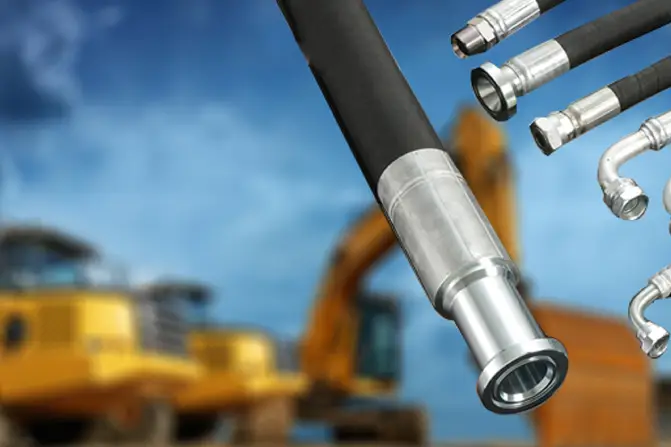
Hydraulic hose manufacturers that provide custom B2B solutions help OEMs, distributors, and industrial users reduce installation issues, improve equipment reliability, and meet application-specific requirements. These suppliers usually offer hose assembly customization, pressure testing, OEM production, and international standard compliance. A professional manufacturer can support working pressures from 70 bar to more than 700 bar, with customized solutions reducing assembly errors by around 20–30% in many industrial applications.
Companies purchasing hydraulic hoses for commercial equipment often need more than standard products. Construction machines, agricultural equipment, mining vehicles, marine systems, and factory automation equipment operate under different pressure, temperature, vibration, and routing conditions. A hose designed for one application may not perform well in another environment.
B2B hydraulic hose suppliers analyze equipment requirements before production. Engineers review factors such as operating pressure, fluid type, temperature range, bending radius, connection style, and expected service hours. For example, a hydraulic system running continuously for 12 hours per day requires different hose materials compared with equipment used only a few hours per week.
A manufacturer providing customized solutions usually offers several production options:
| Custom Service | Application Benefit |
|---|---|
| Hose length adjustment | Reduces installation problems |
| Custom fittings | Matches different machine designs |
| Material selection | Improves resistance to heat and chemicals |
| OEM labeling | Supports distributor branding |
| Assembly service | Saves preparation time |
Many global buyers work with a hydraulic hose factory because it can provide direct engineering communication and production control. A factory with complete manufacturing capability can manage hose cutting, fitting installation, crimping, inspection, and packaging within one production process.
The ability to produce customized hose assemblies is especially important for OEM customers. Equipment manufacturers often require hundreds or thousands of identical assemblies with strict size requirements. A supplier that can maintain consistent production quality helps customers avoid repeated adjustments during equipment assembly.
“A customized hydraulic hose solution starts with understanding the machine, not only selecting a hose size.”
For example, a construction equipment manufacturer may need different hose assemblies for excavators, loaders, and cranes. Although these machines may use similar hydraulic systems, their hose routing, pressure requirements, and movement conditions can vary significantly.
The manufacturing process also affects the quality of customized hydraulic hoses. Professional suppliers normally use automated cutting machines, computerized crimping equipment, and pressure testing systems. These technologies help maintain product consistency during large-volume orders.
Typical quality checks include:
| Testing Process | Purpose |
|---|---|
| Dimensional inspection | Confirms hose and fitting accuracy |
| Pressure testing | Checks leakage resistance |
| Impulse testing | Simulates long-term pressure cycles |
| Material inspection | Verifies rubber and reinforcement quality |
Hydraulic hoses used in heavy equipment may experience thousands of pressure changes during daily operation. Some industrial standards require impulse testing with more than 200,000 pressure cycles to evaluate durability. In 2023, many industrial buyers increased supplier testing requirements as equipment manufacturers focused more on reducing maintenance intervals.
Customization also includes selecting suitable hose structures. Hydraulic hoses are commonly designed with different reinforcement layers depending on pressure requirements.
| Hose Type | Common Use |
|---|---|
| One-wire braided hose | Medium-pressure applications |
| Two-wire braided hose | General industrial equipment |
| Spiral wire hose | High-pressure machinery |
| Multi-layer hose | Heavy-duty systems |
A supplier that understands these differences can recommend suitable products instead of simply matching customer requests. This approach helps avoid problems caused by incorrect hose selection, such as premature wear, leakage, or reduced service life.
International customers also require manufacturers to meet recognized standards. Many B2B buyers check whether suppliers can provide products according to SAE, DIN, EN, or ISO requirements. These standards define requirements for pressure rating, dimensions, materials, and testing methods.
For export-oriented industrial supply chains, certification support is often included in supplier evaluation. Companies purchasing hydraulic hoses for machinery production may request documentation including material reports, inspection records, and product traceability information.
“Reliable suppliers provide both physical products and the technical documents needed for industrial applications.”
Delivery capability is another factor considered by large buyers. A customized hose supplier must balance product variety with production efficiency. Many distributors need different hose sizes, fittings, and packaging formats while maintaining stable delivery schedules.
Manufacturers supporting B2B customers often provide:
-
Small-batch prototype production.
-
Large-volume manufacturing.
-
Customized packaging.
-
Inventory planning support.
-
Technical communication with engineering teams.
For example, an equipment distributor may require 50 different hose assemblies for several machine models. A supplier with flexible production management can organize these variations without affecting product consistency.
Technology investment has also changed hydraulic hose manufacturing. Modern suppliers use digital production records, automated inspection equipment, and computer-based design methods. These systems allow engineers to review hose specifications faster and reduce mistakes during production.
A 2024 industrial manufacturing report showed that suppliers using automated inspection processes could improve production consistency by approximately 15–25% compared with manual inspection methods. Faster information exchange between customers and manufacturers also helps shorten product development periods.
Customer support after delivery is another part of B2B cooperation. Industrial users often need technical assistance when equipment designs change or new applications appear. Manufacturers with experienced engineering teams can provide suggestions on hose routing, fitting selection, and maintenance schedules.
A professional hydraulic hose supplier should usually provide:
| Support Area | Customer Requirement |
|---|---|
| Engineering consultation | Product selection assistance |
| Sample development | Testing before bulk orders |
| Production adjustment | Support for design changes |
| Technical documents | Compliance and maintenance records |
Long-term cooperation between equipment companies and hydraulic hose suppliers depends on production capability, communication efficiency, and quality consistency. A supplier that only provides low-cost products may not meet the requirements of complex industrial applications where reliability and delivery stability are important.
When selecting a manufacturer, buyers often compare several areas:
-
Manufacturing capacity and equipment level.
-
Experience with similar industries.
-
Available hose standards and certifications.
-
Ability to customize fittings and assemblies.
-
Response speed for technical questions.
The right supplier can help companies simplify procurement and maintain stable equipment operation. Customized hydraulic hose solutions are widely used because different industries require different pressure levels, materials, and connection designs.
As industrial equipment continues to become more specialized, B2B hydraulic hose manufacturers with strong engineering support and flexible production systems will continue to serve OEMs, distributors, and machinery companies worldwide. These suppliers provide customized assemblies that match specific equipment requirements while maintaining quality standards for long-term industrial use.